Since ever, humans were dazzled with the views of the sky, the stars, the moon, the sun and the natural phenomena. With time, he discovered new worlds living within our world and then he started to wonder about the other worlds, over there, in the space. Every day, there are new discoveries and new theories to be discussed.

What is the universe? What is life? Light? Time? What are the other worlds in the space? How earth formed? What is our origin? Why are we here? What do we know? What that we don’t? What are our preparations for the future? 

There are thousands of planetariums all around the globe which try to present the answer to these questions and thousands more through producing, with the cooperation of international studios, high quality shows that intrigue the imaginations of the audience in an exciting interesting way.

We, in HorizonsVR and other passionate partners, collected the best of these shows from around the world and integrated them with virtual reality technology to give you an immersive experience that you will never forget. Our shows are suitable for all ages and combine very interesting information in Astronomy, biology, physics, chemistry, mathematics, history, geography, art and much more.

All you need to do is to read through our library of shows and contact us. Our team will help you to customize your exciting experience based on your audience age, interests and subjects. 

We are proud to be the pioneers in providing this service in the Middle East and internationally. 

The journey of us, since day one, to the last day in the future, is in between your hands. So let us start.


To find information about our shows, the way of booking, please check this link
Our shows are varied and available for all ages and are categorized by age group.

From 4 to 12 age             From 6 to 16 age              +10 age

Movies

From 4 to 12 age

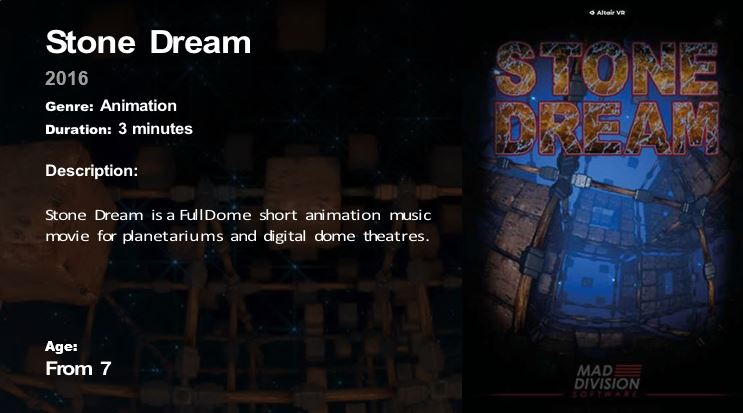
The sinister journey through abandoned mines and underground stations. Mysterious creatures and various dangers wait for brave travelers.

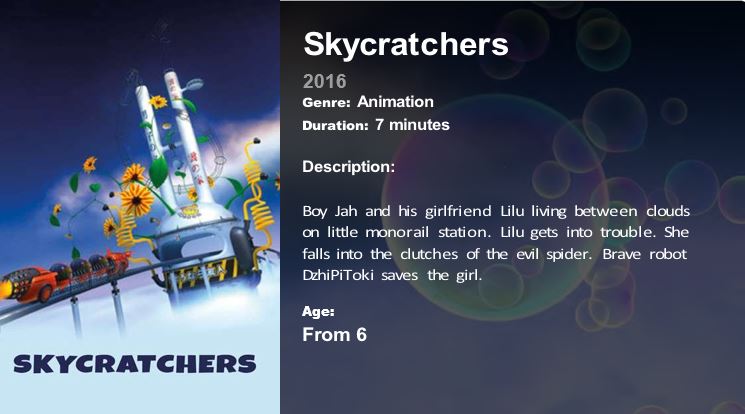
A fulldome roller coaster featuring two robots on a desert island in the middle of the Ocean.

From 6 to 16 age

The show is about the life cycle of Stars. From the birth of star in a stellar nursery to its journey towards a black hole or supernova, “Astralis” explains these phenomena in a very easy narrative. With the eye catchy visuals and lovely music, the show works for all age groups including school audience.

It was the year 1610 when Simon Marius and Galileo Galilee quintupled the concept of ‘Moon’ then known to humanity by discovering Jupiter’s four large satellites. Our solar system now embodies 178 named moons around 8 planets. Even with that amount, the Planets have often overshadowed the moons simply because of their sixes. But as our technology advanced, these minor members of the solar system displayed amazing aspects and facets beyond our wildest imagination. The Moons now outshine their stolid parents in character. Join for a tour of some of the most frigid, violent and absolutely strangest worlds.

In the side arm of spiral galaxy Milky Way we share a small home with a fascinating neighborhood of 8 wondrous Planets and a powerful Sun. These Planets are so different from each other that they hardly can be called from one family, yet they create a perfect harmony. From the burning Sun, lava-ish surface of Venus to the huge stormy belts of Jupiter or the unimaginably beautiful eclipse of Saturn, 8 Scoops of Milky Way is full of never seen footages meant for dome theatres that make you feel the uniqueness and beauty of our Solar system.

+10 Age

Starry skies are a vanishing treasure because light pollution is washing away our view of the cosmos. It not only threatens astronomy but also disrupts wildlife, and affects human health. The glows over cities and towns — seen so clearly from space — are testament to the billions of dollars spent in wasted energy by lighting up the sky. The “Losing the Dark” planetarium show is the result of a collaboration between IDA and Loch Ness Productions. It introduces and illustrates some of the issues regarding light pollution and suggests three simple actions people can take to help mitigate it. The show gives planetarium professionals a tool to help educate the public about the problems of light pollution. Planetariums are uniquely positioned to teach audiences ways we can all work together to implement responsible use of lighting.

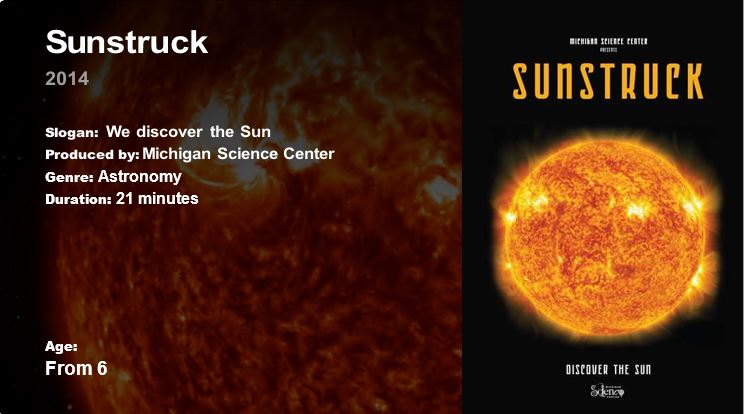
Every second the Sun emits million times more energy than the world consumes every year. Where does such a huge amount of power come from? Discover our star through the breathtaking time lapses. Thanks to the real images taken by the Solar Dynamics Observatory and processed by advanced mathematical methods, you will experience the true nature of the Sun and find out that it is far from being as calm as it seems at first glance. The Sun’s activity, pronounced by terrific solar flares, sunspots and coronal mass ejections, influences our planet, by producing impressive auroras but also by damaging distribution networks and communication satellites. Is it a threat to us, then?

The planetarium documentary “The Hot and Energetic Universe” presents with the use of Immersive Visualization’s and real images the achievements of the modern astronomy, the most advanced terrestrial and orbital observatories, the basic principles electromagnetic radiation and the natural phenomena related to the High Energy Astrophysics. High Energy Astrophysics plays a key role in understanding the universe. These radiations reveal the processes in the hot and violent universe. High Energy Astrophysics probes hot gas in clusters of galaxies, which are the most massive objects in the universe. It also probes hot gas accreting around supermassive black holes in the centers of galaxies.

The Big Bang Theory is one of the leading explanation of “How the universe came into existence? “The universe as we know it, started with a singularity, inflating over the next 13.8 billion years to the cosmos that we know today. Current technology is still insufficient to peer back at the time of universe’s birth. Hence, much of what we understand about the Big Bang Theory came from mathematical theory and models. Fulldome show Once Upon the Big Bang explores the fascinating events of the birth of time and space. The beginning of Universe from an infinitesimal point to a tiny, super-hot region, to the enormous Cosmos of our Era. Enjoy Once Upon the Big Bang: a fulldome show for planetariums and digital theaters.